
Choosing a dog bed looks simple until you own three of them and the dog still sleeps on the rug. The thing that decides whether a bed gets used is rarely the price or the reviews — it is whether the size, the firmness and the position match how your particular dog actually sleeps.
This guide covers all of it: sizing, bed types, materials, placement, and when to spend more. Each section links to a deeper guide if you already know what you are looking for.
Measure your dog lying fully stretched out, nose to tail tip, and add six inches. That is the minimum length. Most sizing mistakes come from measuring a curled-up dog, then discovering the bed is too short the first warm night when the dog wants to sprawl. Width should let the dog lie on its side without a leg hanging off.
As a working guide: under 25 pounds needs roughly 24 by 18 inches, 25 to 50 pounds needs 30 by 20, 50 to 80 pounds needs 36 by 27, and anything over 80 pounds needs 42 by 30 or larger. Breeds that sleep stretched flat — Greyhounds, Dobermans, many sighthounds — need the next size up regardless of weight.
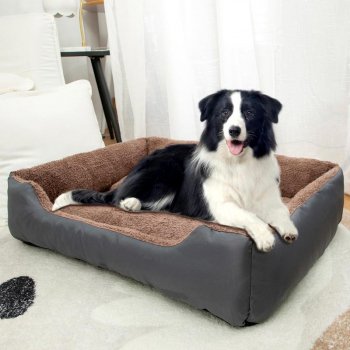
Watch how your dog sleeps before you buy. Curlers want a raised rim or a donut or calming bed. Sprawlers want a flat mattress with no obstruction. Burrowers want a covered or cave-style bed. Older or heavier dogs need firm support, which is what an orthopedic dog bed provides. Dogs that run hot need a cooling bed. Small breeds have their own requirements — see small dog beds.
Firmer than most people expect. A bed that feels luxuriously soft to your hand offers no support once a 60-pound dog compresses it, and a dog that sinks to the floor is sleeping on the floor with extra steps. Press hard with your palm: if you reach the base, the bed is too soft for that dog’s weight.
Solid high-density foam for support, plush or sherpa for warmth, and a tight-weave polyester or canvas cover for durability. Avoid loose shredded filling in anything a heavy dog will use — it migrates into lumps within weeks and leaves the middle flat. Memory foam holds shape best; gel-infused versions run cooler.
Where the dog already sleeps. Dogs choose spots by proximity to the family, temperature, and sightlines to the door — not by where the bed looks best. A bed in a quiet spare room gets ignored no matter how good it is. Most households need two or three beds in different rooms rather than one perfect one.
Two or three. Dogs relocate through the day following warmth, sun, and wherever people are. A single bed cannot track that, which is why the bed you bought gets used at night and ignored all afternoon. A second cheap bed in the room you use most often often gets more hours than the expensive one.
Yes, and specifically a zip-off cover rather than a fully washable bed. Foam and filling degrade in a washing machine, so an all-in-one bed has a short life measured in wash cycles. A removable cover turns washing into routine maintenance instead of a decision. See washable dog beds for the options.
Every one to two years for a stuffed bed, three to five for solid foam. The test is rebound: press the surface and watch how fast it recovers. When it stays compressed, it has stopped supporting the dog regardless of how it looks. Covers usually need replacing long before the core does.

Browse the full beds and furniture range, or start here:
Also browse mats and houses, or all pet supplies.

Dogs will sleep somewhere regardless, so a bed is about controlling where. It keeps joints off hard floors, contains hair in one washable place, and gives the dog a defined spot of its own — which matters most in busy households and homes with other pets.
Usually placement or size, not the bed. Move it to where the dog already naps before concluding anything. Beyond that, check it is long enough for a full stretch and firm enough not to bottom out. A dog that tried a bed once and sank through it tends not to try again.
Both, ideally. A flat mat sized exactly to the crate floor works inside, since bulky bolsters waste the limited space. Keep a separate proper bed in the living area — crate time and rest time serve different purposes and dogs treat the spaces differently.
Not harmful, but sofas rarely support a heavy or older dog well, and jumping up and down repeatedly is harder on joints than stepping onto a floor-level bed. If your dog prefers the sofa for the elevation and the company, a dog sofa bed nearby is the usual compromise. For joint concerns, the Cornell Riney Canine Health Center is a reliable reference.

If you have any questions, here are some useful links:





Leave a comment