
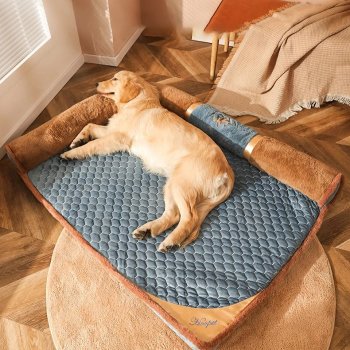
A dog sofa bed is the shape most dogs pick when given a choice. Raised sides to lean against, an open front to step over rather than climb, and a base wide enough to stretch out when the room gets warm. It is the couch-shaped compromise between a flat mat and a fully enclosed bed.
It is also the type most often bought in the wrong size, because the raised sides eat into the usable sleeping area in a way flat beds do not.
A dog sofa bed has a cushioned base with bolstered sides on three edges and an open front, mirroring the shape of a human couch. The bolsters serve as a headrest and a backrest, which matters because dogs instinctively sleep with their spine against something solid. The open front lets an older or shorter dog walk in rather than climb.
Pressing against a raised edge provides the same security a wall or furniture leg gives a dog sleeping on the floor. It also supports the neck, which is why dogs drape their heads over bolsters rather than lying flat. In a busy room, the raised back cuts off one direction of sightline and lets the dog relax faster.
Measure the internal sleeping area, not the external dimensions. Bolsters commonly consume four to six inches on each side, so a bed listed as 36 inches wide may offer only 26 inches of actual surface. Your dog needs to lie fully stretched within that internal measurement, not within the number on the box.
Bolsters win for most dogs — the head support and enclosure suit how they sleep. A flat mattress wins for dogs that sprawl fully extended, for crate use where every inch counts, and for dogs with mobility problems who find even a low edge awkward. Very large breeds also tend to outgrow the usable area of bolstered beds faster.
The headrest helps, the edge can hinder. A senior dog with stiff joints benefits from the neck support but may struggle to step over a high bolster. Look for a design with a genuinely low or dipped front entry, and check the base is firm enough that standing up does not mean pushing out of a hollow.
A firm base rather than a soft one, bolsters that hold their stuffing instead of collapsing within a month, a non-slip underside so the bed does not slide on hard floors when the dog jumps in, and a removable cover. Bolster collapse is the most common failure — press one and see whether it springs back.

From beds and furniture and mats and houses:
Need more support instead? See orthopedic dog beds, or start with the complete dog bed buying guide.

For most dogs, yes — the bolsters provide head support and a sense of enclosure that flat beds do not. The exceptions are dogs that sleep fully stretched out, very large breeds, and dogs with mobility issues who find the raised edge an obstacle rather than a comfort.
Only if both fit within the internal area lying down at once, which usually means sizing up two steps rather than one. Dogs that sleep touching will share happily; dogs that compete for space will not, and the lower-ranking dog quietly stops using it.
Choose one with a non-slip base, or put a rubber mat underneath. Sliding is more than a nuisance — a bed that shifts as the dog lands teaches the dog the surface is unstable, and that is usually enough for it to stop using the bed altogether.
Remove and machine wash the cover cool, vacuum the bolsters weekly with an upholstery attachment, and spot-clean with enzyme cleaner rather than bleach. Bolsters rarely fit in a domestic machine, so a design with a fully removable cover is the only version that stays genuinely clean long term.

If you have any questions, here are some useful links:




Leave a comment