
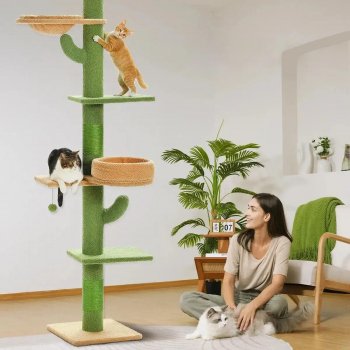
A floor to ceiling cat tree solves one specific problem: real vertical height with almost no floor space. If you rent, or you live in 600 square feet, or your landlord has opinions about drilling, a floor-to-ceiling cat tree is the only way to give a cat real height without giving up floor. It braces under tension between floor and ceiling — no screws, no studs, no holes.
It is also the design most likely to go wrong on arrival, because almost nobody measures first.
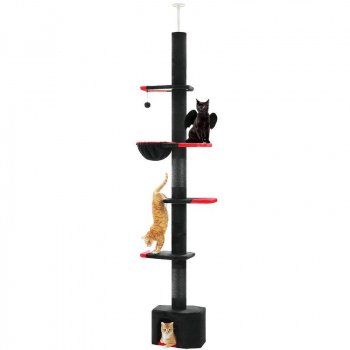
A threaded tension mechanism at the top extends against the ceiling, locking the post between two fixed surfaces through compression. No fixings enter the wall or ceiling. The load path runs straight down through the post into the floor, which is why these units hold weight well despite their narrow base.
Every adjustable model covers a fixed range — commonly 7.5 to 9 feet — and will not tension correctly outside it. Measure floor to ceiling at the exact spot you intend to install, not in the middle of the room. Older homes, sloped ceilings, and thick carpet all shift the number enough to matter.
Yes, but tension settles as the carpet compresses over the first few days. Re-tighten after 48 hours and again after a week. On deep pile, a thin rigid board under the base spreads the load and stops the post sinking unevenly, which is the usual cause of a lean developing.
No. Tension poles need a solid surface above. A drop ceiling tile will crack or lift, and the pole loses its top anchor without warning. If the ceiling is not solid, use a wide-base freestanding tree instead — the risk here is not worth the floor space saved.
Roughly one square foot at the base, against four or more for a conventional tree of similar height. That is the entire argument for this design. In a studio or a narrow hallway corner, it is often the difference between a cat having vertical territory and not.
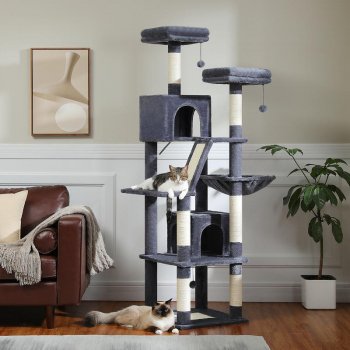
For cats up to about 15 pounds, yes, provided tension is correct and re-checked monthly. Beyond that, the narrow base becomes a liability when a heavy cat pushes off sideways at height. Large breeds are better served by a wide-base unit — see cat trees for large cats.

Browse all cat scratchers and cat furniture, or start with the complete cat tree buying guide. Considering mounted shelves instead? Read cat wall shelves.

Correctly tensioned, no — pressure spreads across a padded plate rather than a point. Over-tightening is what causes marks or cracked plaster. Tighten until firm and the pole no longer rotates by hand, then stop. More tension does not mean more stability.
After 48 hours, after the first week, then monthly. Floors settle, carpet compresses, and seasonal humidity moves timber ceilings slightly. A pole that was solid in July can develop play by October, and cats notice movement long before owners do.
Yes — release the tension, move it, re-measure and re-tension at the new spot. Ceiling height often differs between rooms in the same home, so confirm the new height sits within the model’s range before committing.
For general indoor cat enrichment guidance, the Cornell Feline Health Center is a reliable reference.

If you have any questions, here are some useful links:



Leave a comment