
A cat wand toy is the most effective toy you can own, and the least likely to be used correctly. Most people wave it. Cats do not chase things that wave — they chase things that hide, dart, and try to get away.
Change how you move it and a cat that “does not play” usually turns out to play perfectly well.
Because you control the prey. A toy on the floor is inert; a wand lets you make the target behave like something alive — pausing, hiding behind furniture, darting away at the wrong moment. That unpredictability is what engages the hunting sequence, and no self-running toy reproduces it as well as a human hand.
Move it away from the cat, never toward it. Prey flees; it does not advance. Drag it around corners, let it disappear behind a chair leg, pause it completely so the cat has to commit, then move again just as the cat readies a pounce. Fast constant waving above the cat’s head reads as nothing recognisable and gets ignored.
Usually because it has never caught anything. A cat that stalks and chases and never connects becomes frustrated and disengages. Let the cat catch the toy several times during a session and end with a definite capture — that closure is what makes play satisfying rather than teasing.
Feathers move erratically and suit birds-in-flight play — good for cats that leap. Ribbon and string move in a ground-level snake motion that suits cats who stalk low. Mouse and plush attachments give something substantial to bite and rabbit-kick at the end. Most cats have a clear preference, and interchangeable attachments let you find it cheaply.
Unsupervised, yes — genuinely. Swallowed string, ribbon and tinsel cause linear foreign body obstructions, which are serious and often surgical. A wand toy is a supervised-play item that gets put away in a drawer afterwards, every time, without exception.
Ten to fifteen minutes, two or three times a day. Cats hunt in short intense bursts rather than sustained sessions. Stop while the cat is still interested rather than playing until it walks off — ending on engagement makes the next session easier to start.
Dawn and dusk match a cat’s natural activity peaks, and a session shortly before bed followed by a meal reproduces the hunt-eat-groom-sleep cycle. That sequence is the most reliable fix for a cat that wakes the household at 4am.

From pet toys:
See also interactive cat toys and catnip toys.
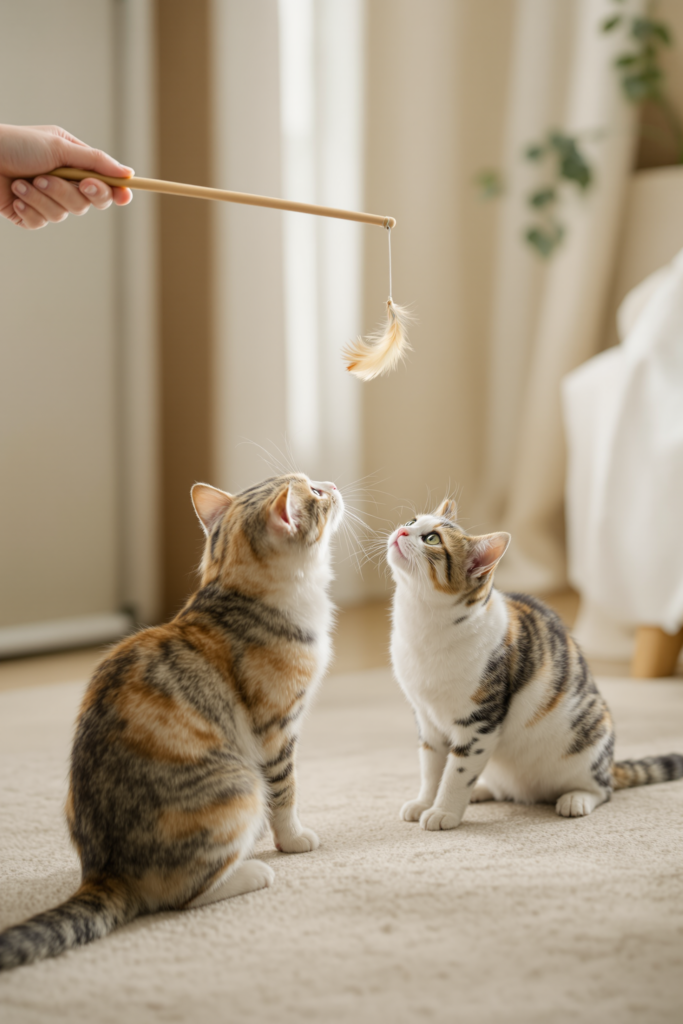
Try moving it away and more slowly, with pauses. Most non-playing cats are responding to movement that does not resemble prey. Low, slow, and hiding works far better than fast and overhead — and older cats especially prefer ground-level stalking to aerial chasing.
No. String, ribbon and feathers are swallowing hazards and cause serious intestinal injuries. Wands come out for a session and go in a drawer afterwards. Leave solid toys with no strings for unsupervised play.
When the string frays or the attachment starts shedding pieces. A worn attachment is a swallowing risk, and a frayed string breaks mid-pounce. Replacement attachments cost a fraction of a whole new wand.
They help with the ones caused by unspent prey drive — ankle attacks, night activity, over-grooming from boredom. They do not address anxiety or territorial conflict between cats. For behaviour guidance, International Cat Care is a reliable non-commercial source.

If you have any questions, here are some useful links:


Leave a comment