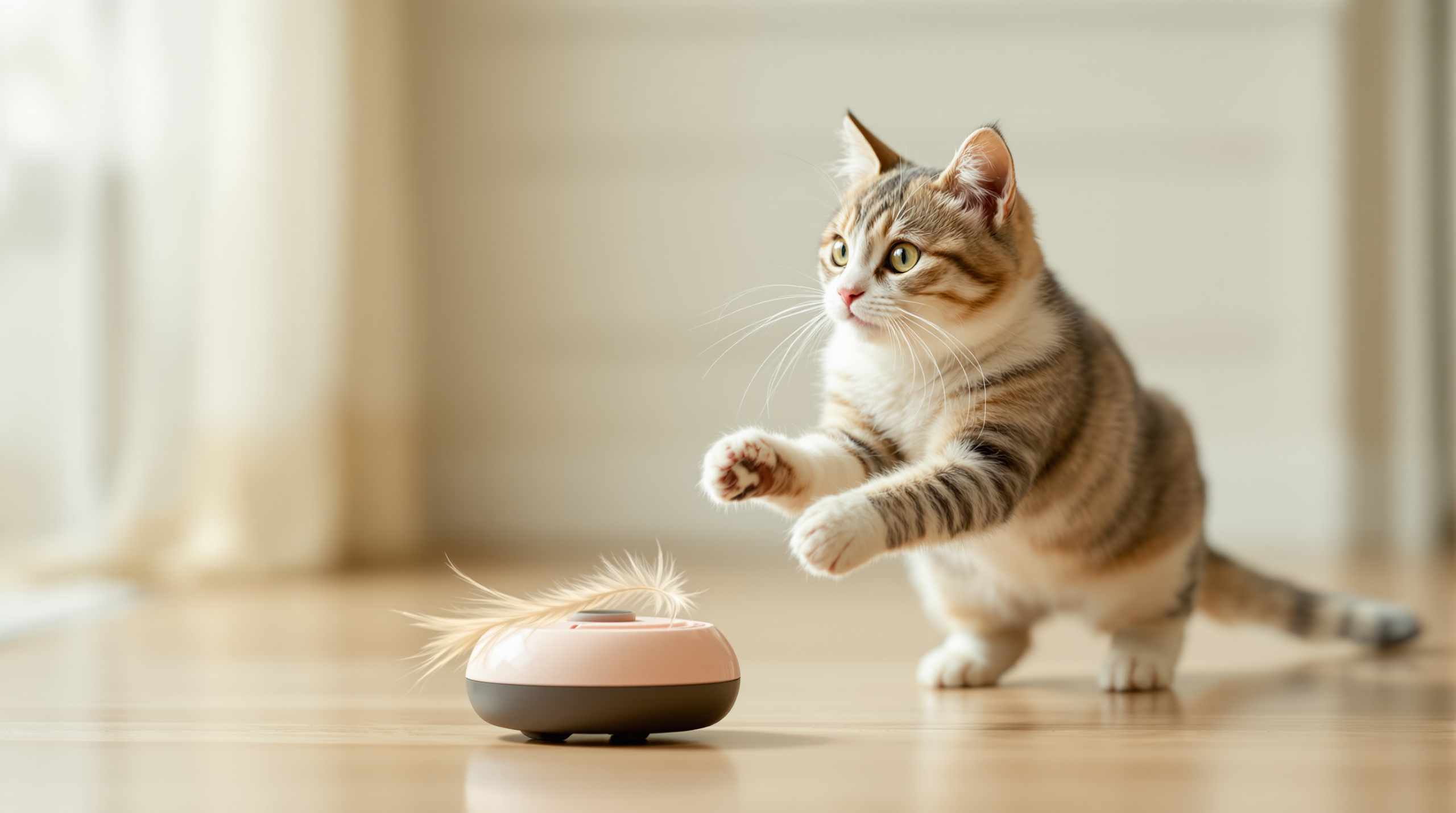
Interactive cat toys exist to solve a problem specific to indoor cats: a hunting sequence with no prey at the end of it. Cats are built to stalk, chase, pounce and catch several times a day, and a bowl of kibble completes none of that.
The toys that work are the ones that let the cat finish the sequence. The ones that fail are the ones that never let it win.
Movement the cat does not control. A ball on the floor is a static object; a ball that rolls away unpredictably, a feather that darts, a laser that moves erratically — those trigger the prey drive because they behave like something trying to escape. Interactive toys split into ones you operate and ones that run themselves.
Because the hunting sequence never completes. A cat that stalks and chases but never catches anything becomes frustrated rather than satisfied, and disengages. Every play session should end with the cat physically catching something it can bite and kick — that closure is what makes the session count.
Used alone, they are the clearest example of the problem above. The dot can never be caught, so the cat never resolves the sequence and some become anxious or obsessive about lights and reflections. Used correctly — ending every session by landing the dot on a physical toy or treat the cat can actually grab — they are fine.
For cats home alone, yes, within limits. Motion-activated and self-rolling toys provide bursts of stimulus through the day that a static toy cannot. Most cats habituate to a single automatic toy within a few weeks, so rotate two or three rather than leaving one running permanently.
Two or three sessions of ten to fifteen minutes beats one long one. Cats hunt in short intense bursts rather than sustained exercise, and a session that runs past the cat’s interest teaches it that play ends in boredom. Stop while the cat still wants more.
Dawn and dusk, when cats are naturally most active, and one session shortly before your bedtime. A play session followed by a meal mimics the hunt-eat-groom-sleep cycle and is the most reliable way to stop a cat waking you at 4am.
Wand toys with string are not — string and ribbon cause serious intestinal injuries if swallowed, so wands go away between sessions. Solid automatic toys with no removable parts are generally fine to leave out. Check battery compartments are secured on anything electric.

From pet toys:
See also cat wand toys for hands-on play and catnip toys for solo enrichment.

More than outdoor cats do. An outdoor cat completes hunting sequences naturally; an indoor cat has that outlet removed entirely. Unused prey drive shows up as ankle attacks, night-time zoomies and over-grooming rather than simply disappearing.
Five or six in rotation, with two or three available at a time. Swapping them weekly keeps them novel. A basket of twenty permanently available toys produces a cat that ignores all of them, because nothing in it is new.
No. Automatic toys fill the hours you are out; they do not replace interactive sessions with you, which also serve the bond between you. Think of them as supplementary rather than a substitute.
Yes — cats hunt in short bursts and a two to five minute session is a complete one for many cats. Several short sessions through the day suit their natural rhythm better than one long one. For enrichment guidance, International Cat Care is a reliable non-commercial source.

If you have any questions, here are some useful links:


Leave a comment