
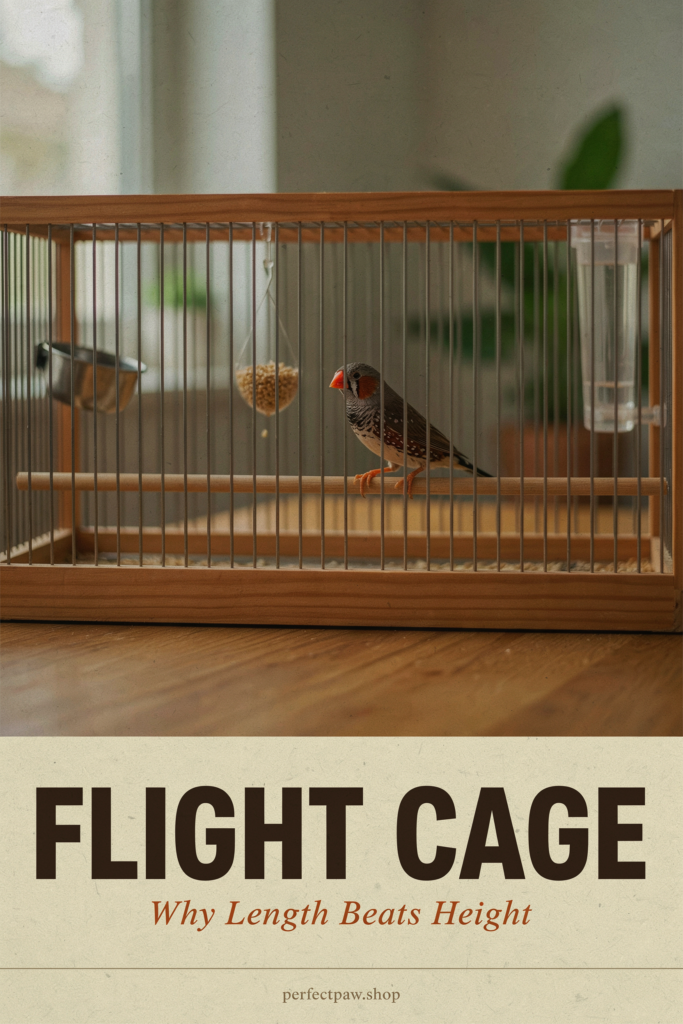
A flight cage is defined by one dimension: length. It is built wide enough that a bird can take actual wingbeats between two end perches rather than hopping and climbing. For finches, budgies and canaries — species that get little or no out-of-cage time — that difference is the whole quality of life question.
Proportion, not just volume. A flight cage is markedly longer than it is tall, with perches at the two ends and open space between them. A tall cage of the same cubic volume offers no flight path at all, because birds do not gain useful exercise flying vertically inside a column.
Species that stay caged most of the time — finches, canaries, budgies kept in pairs or groups — and any bird whose household cannot offer reliable daily out-of-cage time. Larger parrots benefit too, but they need supervised time outside the cage regardless of how big it is; no cage substitutes for that.
Enough for several unbroken wingbeats. For finches and canaries, 90cm of length is a practical floor and more is better; budgies want at least that. The test is behavioural rather than numerical — if the bird flies end to end repeatedly during the day, the length is working. If it only climbs, it is not.
For small finches largely yes, because they are rarely handled and get genuine exercise inside. For parrots and cockatiels, no. The AVMA’s guidance on selecting a bird notes they need appropriate cages plus supervised daily exercise outside the cage, and social species also need the interaction that comes with it.
Perches at the two ends, food and water at one end, toys against the sides — and the middle third left completely clear. The most common mistake is furnishing a flight cage like a standard one, hanging toys through the centre. That removes the flight path and turns an expensive cage into a large ordinary one.
See the bird cage guide and the bird perch guide, or browse Bird Supplies.
That is often the point of one. Compatible finches and budgies do well in groups given enough length, multiple feeding stations so no bird guards the food, and more perches than birds. Watch for one individual monopolising the best perch — that is the earliest sign the group is too large for the space.

Yes, particularly if out-of-cage time is limited. Length is what gives the bird exercise.
Against a wall, out of draughts and direct sun, away from the kitchen. Two solid sides reduce stress.
No — spacing follows the species, not the cage type.
Only with shade, shelter, predator-proofing and secure latches. Most are designed for indoor use.
Daily liner change and bowls, weekly perches, monthly full wash. Castors make moving it to clean far easier.
Only if the middle is clear. Furnish the ends and leave the flight path open.

If you have any questions, here are some useful links:


Leave a comment