
A donut dog bed is the round, deep-rimmed style sold almost everywhere as a calming bed. The shape is not marketing: the raised edge supports the head and spine while the dog curls, and the enclosed feel suits dogs that sleep nose-to-tail rather than sprawled flat.
Whether it calms an anxious dog is a more honest question, and the answer is more limited than the packaging suggests.
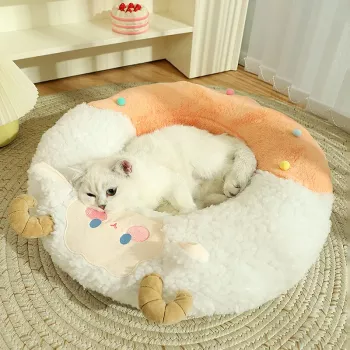
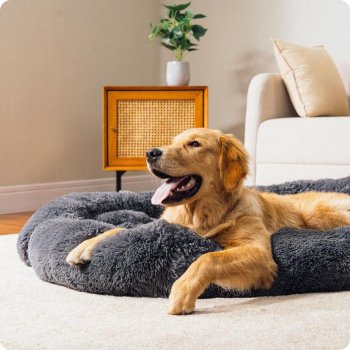
A circular or oval bed with a continuous raised rim and a soft sunken centre, usually finished in long-pile faux fur. The dog curls into the dip and rests its head on the rim. The design targets the curling sleep posture specifically, which is why sprawlers often ignore it.
They help some dogs settle, and that is the honest claim. The raised rim gives constant physical contact on all sides, which many dogs find reassuring in the same way a den or a corner does. What they do not do is treat separation anxiety, noise phobia or a genuine behavioural disorder — those need a plan, and often a vet or a behaviourist.
Dogs that curl tightly to sleep, dogs that seek out corners and gaps behind furniture, small and medium breeds, and dogs that feel the cold. Large breeds that stretch out fit poorly unless you size up considerably, and dogs that sleep on their side with legs extended will hang over the rim and stop using it.
Measure your dog curled up, then add four to six inches of diameter — not the stretched-out measurement used for flat beds. This is the one bed type where you size to the curled dog. Remember the rim consumes several inches, so compare the internal diameter rather than the external one.
They are among the warmest shapes available, because the rim blocks draughts on every side and the deep pile traps body heat. That makes them a strong choice for winter and for small or thin-coated dogs, and a poor one in a hot room, where the same enclosure becomes a problem.
The centre does, eventually, and the rim collapses before the base does. Beds filled with loose fibre lose loft within months in daily use. Press the rim: if it stays compressed rather than springing back, the support has gone even though the bed still looks full. For heavy or senior dogs, an orthopedic bed holds up far longer.
Most are fully machine washable, which is an advantage over foam beds — but wash cool and air dry, since heat mats the pile permanently and the bed never recovers its texture. Shake the rim back into shape while damp. Expect to wash every two to four weeks in normal use.

From beds and furniture and mats and houses:
Also see the complete dog bed buying guide. Persistent anxiety is worth discussing with a vet — the Cornell Riney Canine Health Center is a reliable starting point.

It may help a dog settle and sleep more soundly, but it will not resolve separation anxiety, noise phobia or reactivity. Those need training, routine changes and sometimes veterinary input. Treat the bed as one supportive element rather than a solution on its own.
It conserves body heat and protects the abdomen, both inherited from sleeping outdoors without shelter. Dogs that curl tightly year-round are usually managing warmth; dogs that curl only in winter and sprawl in summer are simply thermoregulating, which is normal.
They can be, if you size up properly — most large dogs need a diameter well beyond what is marketed as large. The limitation is that big dogs are more likely to sprawl, and a sprawler on a donut bed ends up with its legs over the rim.
One to two years in daily use before the rim loses its loft and the centre flattens. Washing extends the look but not the structure. Foam-filled versions outlast fibre-filled ones considerably, though they lose the soft sink that makes the shape appealing.

If you have any questions, here are some useful links:



Leave a comment