
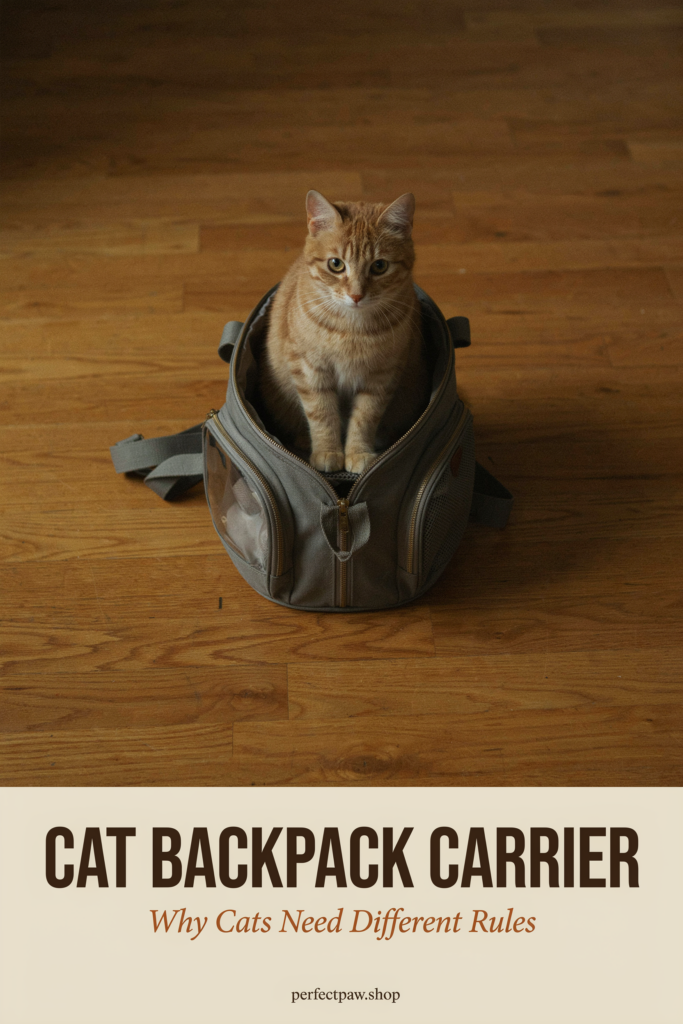
A cat backpack carrier is not a small dog backpack with a cat in it. Cats respond to transport differently — they hide rather than seek reassurance, they overheat quietly, and they treat an unfamiliar enclosed space as a threat until proven otherwise. The equipment choices follow from that, and so does the training timeline.
Enclosure and stability. Cats settle better in a carrier with more solid sides and less visibility than dogs do, because exposure reads as vulnerability. They also need a firm flat base to sit upright on rather than a sling that moves under them with each step, which is why soft-bottomed packs are poorly tolerated by most cats.
They photograph well and ventilate poorly. A rigid dome traps heat and limits airflow, and a cat that cannot cool itself will not show distress in ways that are easy to read from behind you. If you use one, choose a model with substantial side mesh as well, keep journeys short, and check the cat frequently.
Weeks, not days. Leave it open at home permanently with a familiar blanket inside and treats appearing in it at random. The goal is a carrier the cat sleeps in voluntarily. The ASPCA recommends acclimating pets through a series of short drives first, gradually lengthening time spent in the car. A carrier that only comes out before the vet becomes a predictor of bad events, and the cat learns to disappear when it sees it.
Open-mouth breathing or panting in a cat is not normal and is an immediate reason to stop, open the carrier somewhere secure, and cool the animal. Drooling, lethargy and very red gums are further signs. Cats pant far less readily than dogs, so panting indicates a problem that has already developed.
A well-fitted harness is useful insurance for the moment the carrier opens, which is when escapes happen — in a vet car park or on a station platform. It should not be clipped to anything inside the pack, where a lead could tangle. Fit it at home and let the cat wear it around the house first.
See the pet carrier backpack guide or browse Walking & Traveling Supplies.
Some cats enjoy it; many find it stressful without showing it obviously. The honest test is whether the cat enters the carrier voluntarily and settles within a few minutes outside. A cat that freezes motionless is not calm — freezing is a stress response, and stillness in a carrier is easy to misread as contentment.

Most are rated to around 7kg. Larger cats need a conventional carrier with more floor space.
No. There is not enough room, and confinement raises tension even between bonded cats.
Latch the zips together with a clip, and fit a harness. Cats work zips open with a paw.
Only if the cat prefers it. A conventional carrier is easier to open flat on an exam table.
A familiar-smelling blanket and nothing loose. Familiar scent settles cats more than anything you can buy.
Go back to home conditioning. Continuing through distress makes the next trip harder, not easier.

If you have any questions, here are some useful links:


Leave a comment